> ## Documentation Index
> Fetch the complete documentation index at: https://hoopdev-update-to-meta-tags.mintlify.site/llms.txt
> Use this file to discover all available pages before exploring further.
# MongoDB
> A MongoDB connection is a native type, allowing for the auditing of queries and redaction of their output. It facilitates a local TCP connection without requiring a password.
## Prerequisites
To get the most out of this guide, you will need to:
* Either [create an account in our managed instance](https://use.hoop.dev) or [deploy your own hoop.dev instance](/getting-started/installation/overview)
* You must be your account administrator to perform the following commands
This integration only accepts [SCRAM authentication](https://www.mongodb.com/docs/manual/core/security-scram/#scram) for native connections.
## Features
The table below outlines the features available for this type of connection.
* **Native** - This refers to when a database client connects through a specific protocol, such as an IDE or client libraries through `hoop connect `.
* **One Off -** This term refers to accessing this connection from hoop web panel.
| Feature | Native | One Off | Description |
| ------------------------------ | --------------------- | --------------------- | ----------------------------------------------------------------------------------------------------------------------- |
| TLS Termination Proxy | | | The local proxy terminates the connection with TLS, enabling the connection with the remote server to be TLS encrypted. |
| Audit | | | The gateway stores and audits the queries being issued by the client |
| Data Masking (Google DLP) | | | A policy can be enabled to mask sensitive fields dynamically when performing queries in the database. |
| Data Masking (MS Presidio DLP) | | | A policy can be enabled to mask sensitive fields dynamically when performing queries in the database. |
| Credentials Offload | | | The user authenticates via SSO instead of using database credentials. |
| Interactive Access | | | Interactive access is available when using an IDE or connecting via a terminal for analysis exploration. |
## Configuration
| Name | Type | Required | Description |
| ------------------ | ------- | -------- | ----------------------------------------------------------------------------------------------------------------------------------------------------------------------------------------------------------------- |
| CONNECTION\_STRING | env-var | yes | The MongoDB connection string. See [https://www.mongodb.com/docs/manual/reference/connection-string/](https://www.mongodb.com/docs/manual/reference/connection-string/) for more details about the proper format. |
## Connection Setup
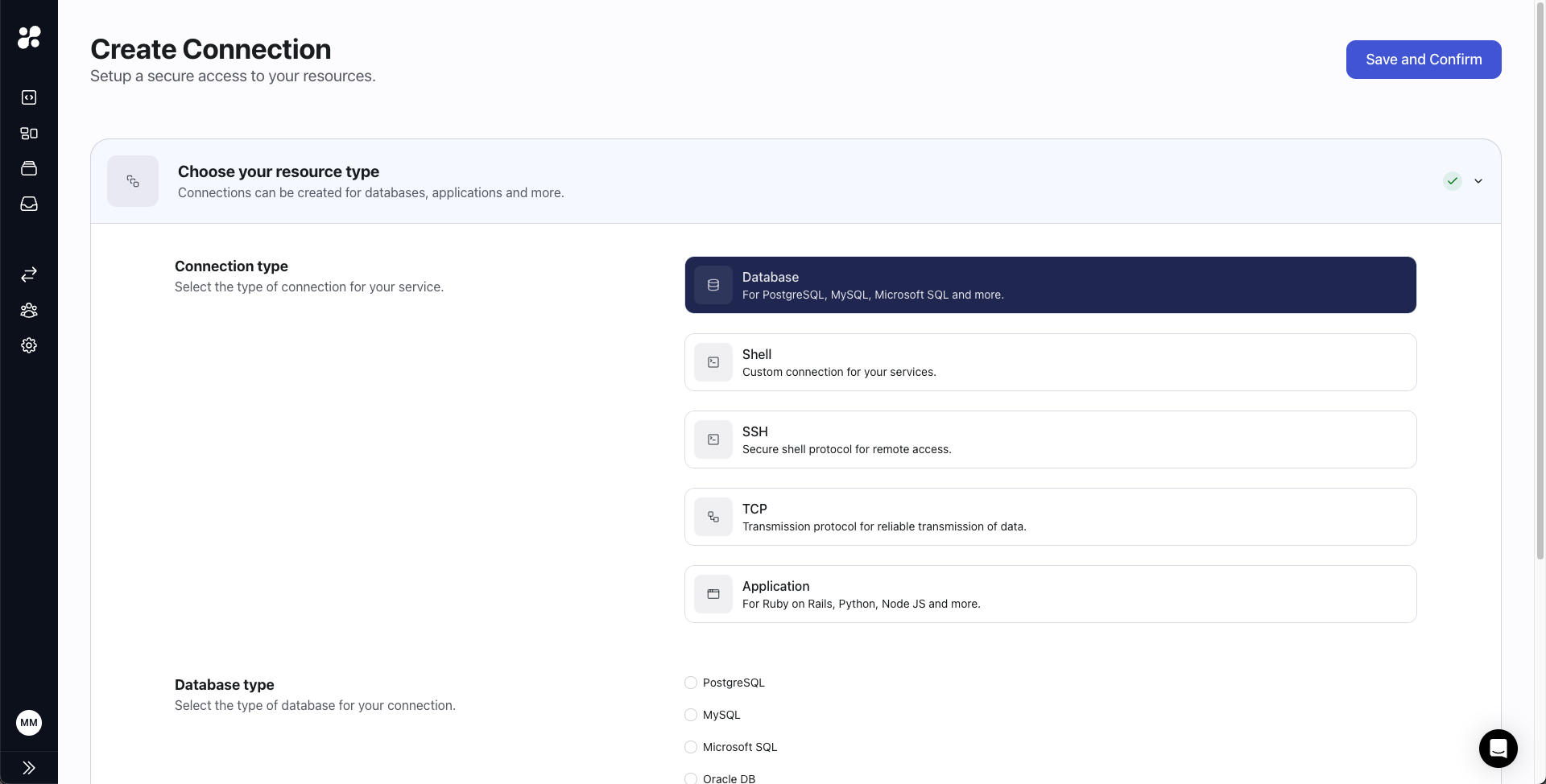
Create a new Database connection in hoop's web panel.
 ## Connection Usage
You can access it through hoop CLI or hoop web panel.
### Hoop CLI
```bash
hoop connect
connection: mongo | session: f2e7634a-f4c4-47cd-bee6-48da080e2a23
---------------------mongo-credentials----------------------
mongodb://noop:noop@127.0.0.1:27018/?directConnection=true
------------------------------------------------------------
```
Clients must use `noop` as both the username and password, along with the `directionConnection=true` option
### Web panel
## Connection Usage
You can access it through hoop CLI or hoop web panel.
### Hoop CLI
```bash
hoop connect
connection: mongo | session: f2e7634a-f4c4-47cd-bee6-48da080e2a23
---------------------mongo-credentials----------------------
mongodb://noop:noop@127.0.0.1:27018/?directConnection=true
------------------------------------------------------------
```
Clients must use `noop` as both the username and password, along with the `directionConnection=true` option
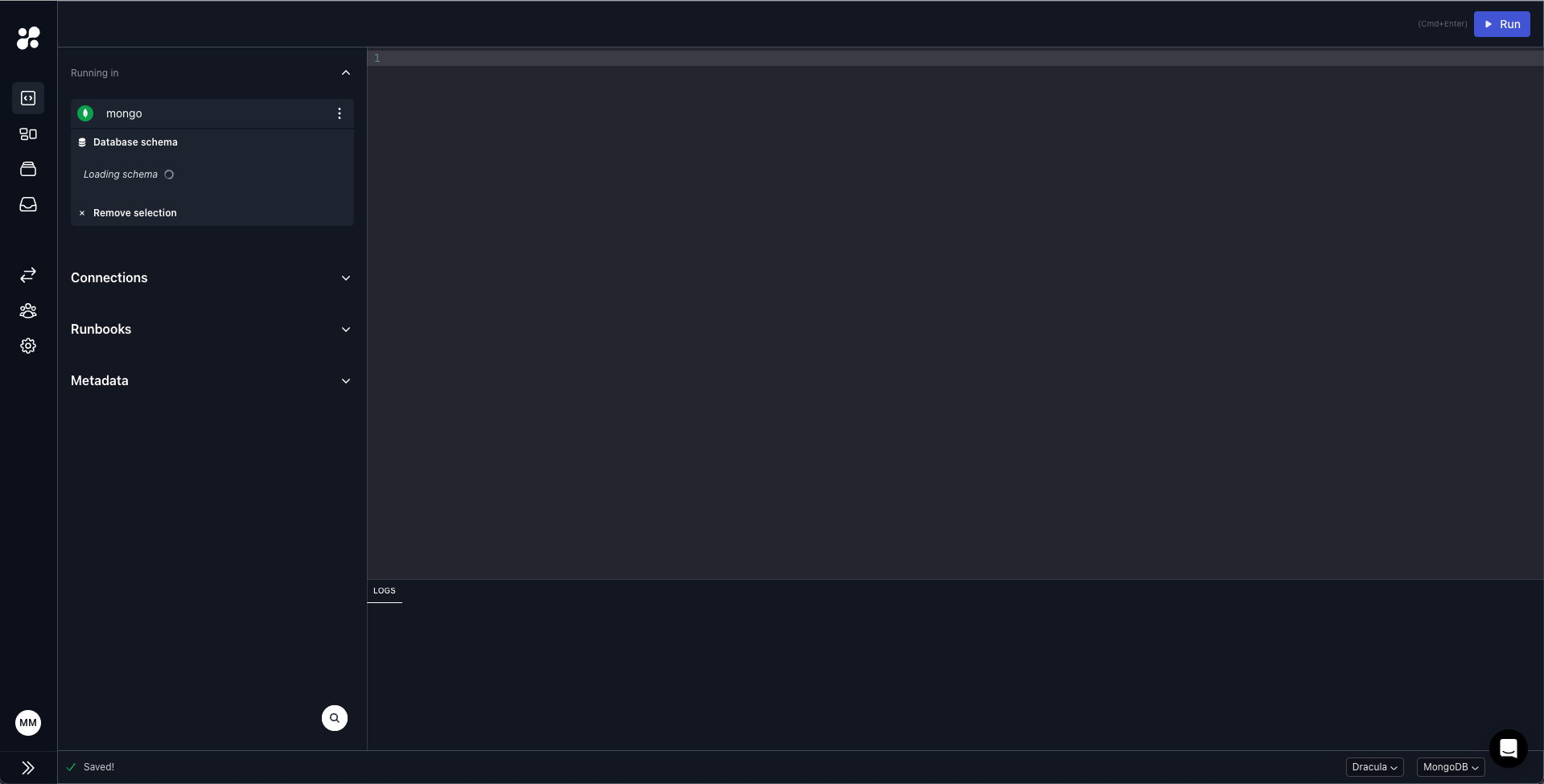
### Web panel
 ## Known Issues
### Clients advertising the wrong server
The **native** implementation has a known issue in cluster setups where clients may incorrectly advertise connections to the wrong server.
Hoop selects a server at random and attempts to upgrade the connection to the primary server.
However, this transition is not properly propagated to clients, resulting in the advertisement of incorrect server information.
Users can manually switch to the primary server after connecting to a secondary server. For example, using `mongoshell`:
```sh
> db.getMongo().setReadPref('primary')
```
### Syntax Error Issues
The one-off execution uses the `mongo` legacy utility as a client to execute scripts.
Since input is provided through stdin, syntax errors may occur for more complex inputs.
To avoid these issues, use `mongosh` instead.
Add the comment in the beginning of the script to indicate that it should be executed with `mongosh`:
```sh
// mongosh
use sample_airbnb
db.listingsAndReviews.find({}, {_id: 1}).limit(10)
```
This feature is available in agent version `1.35.19` and later.
## Known Issues
### Clients advertising the wrong server
The **native** implementation has a known issue in cluster setups where clients may incorrectly advertise connections to the wrong server.
Hoop selects a server at random and attempts to upgrade the connection to the primary server.
However, this transition is not properly propagated to clients, resulting in the advertisement of incorrect server information.
Users can manually switch to the primary server after connecting to a secondary server. For example, using `mongoshell`:
```sh
> db.getMongo().setReadPref('primary')
```
### Syntax Error Issues
The one-off execution uses the `mongo` legacy utility as a client to execute scripts.
Since input is provided through stdin, syntax errors may occur for more complex inputs.
To avoid these issues, use `mongosh` instead.
Add the comment in the beginning of the script to indicate that it should be executed with `mongosh`:
```sh
// mongosh
use sample_airbnb
db.listingsAndReviews.find({}, {_id: 1}).limit(10)
```
This feature is available in agent version `1.35.19` and later.